
Archive Search
Advanced Options
Academy Forum | Russia's War Against Ukraine - An Update
December 10, 2026
7:30 p.m.–9:00 p.m. ET
WEBINAR
REGISTER FOR THE ZOOM WEBINAR >
Join us for the seventh program in an ongoing series examining Russia's war against Ukraine. Since the series began in May 2022, leading scholars Timothy Frye, Oxana Shevel, and Gideon Rose have provided timely analysis of the conflict and its implications for international politics.
More than a year following their last discussion together, this panel will assess recent developments in the war, examine the evolving political and security landscape, and consider the challenges and prospects ahead. The program will feature a moderated discussion followed by audience Q&A.
This virtual event is co-sponsored with the Network for Responsible Public Policy.
TIMOTHY FRYE is the Marshall D. Shulman Professor of Post-Soviet Foreign Policy at Columbia University. He received a B.A. in Russian language and literature from Middlebury College, an M.I.A. from Columbia’s School of International and Public Affairs, and a Ph.D. in Political Science from Columbia. His research and teaching interests are in comparative politics and political economy, focusing on the former Soviet Union and Eastern Europe. His most recent book is Weak Strongman: The Limits of Power in Putin’s Russia. He also edits Post-Soviet Affairs.
OXANA SHEVEL is a professor of comparative politics at the Department of Political Science at Tufts University. Her research and teaching focus on the post-Soviet region, especially Ukraine and Russia, and issues such as nation-building and identity politics, citizenship policies, memory politics, church-state relations, and the democratization process in the post-Soviet region. Her most recent book (co-authored with Maria Popova)—Russia and Ukraine: Entangled Histories, Diverging States (Polity, 2024)—examines the root causes of the Russo-Ukrainian war and locates them in the growing domestic political divergence between Russia and Ukraine post-1991. Professor Shevel holds a Ph.D. in Government from Harvard University, an M.Phil in International Relations from the University of Cambridge in England, and a B.A. in English and French from Kyiv State University in Ukraine.
GIDEON ROSE is senior lecturer in discipline at the School of International and Public Affairs at Columbia University and adjunct senior fellow at the Council on Foreign Relations. Previously, he was managing editor of Foreign Affairs from 2000 to 2010 and editor from 2010 to 2021. He has also served as associate director for Near East and South Asian affairs on the staff of the National Security Council and deputy director of national security studies at CFR. He is the author of How Wars End (Simon & Schuster, 2010).
ROBERT Y. SHAPIRO is the Wallace S. Sayre Professor of Government in the Department of Political Science and Vice Dean and Professor of International and Public Affairs at Columbia University. He is President of The Academy of Political Science and Editor of Political Science Quarterly.
MARYLENA MANTAS is Assistant Professor in the Department of Political Science and Global Affairs at Sacred Heart University and Associate and Managing Editor of Political Science Quarterly.
The Academy of Political Science
Network for Responsible Public Policy
Join the Academy of Political Science and automatically receive Political Science Quarterly.
Academy Forum | Russia's War Against Ukraine - An Update
December 10, 2026
7:30 p.m.–9:00 p.m. ET
WEBINAR
CONTRIBUTIONS TO POLITICAL SCIENCE
Governing by Decree: The Trump Presidency and the Decline of “Legislating Together”
Desmond King
Publishing since 1886, PSQ is the most widely read and accessible scholarly journal with distinguished contributors such as: Lisa Anderson, Robert A. Dahl, Samuel P. Huntington, Robert Jervis, Joseph S. Nye, Jr., Theda Skocpol, Woodrow Wilson
view additional issuesArticles | Book reviews
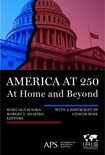 |
AMERICA AT 250:
AT HOME AND BEYOND |
The Academy of Political Science, promotes objective, scholarly analyses of political, social, and economic issues. Through its conferences and publications APS provides analysis and insight into both domestic and foreign policy issues.
With neither an ideological nor a partisan bias, PSQ looks at facts and analyzes data objectively to help readers understand what is really going on in national and world affairs.


